Safety in Embodied AI

Safety in Embodied AI:
A Survey of Risks, Attacks, and Defenses

📄 Paper PDF CC BY-NC-SA 4.0 Awesome 480+ Papers Maintained
1 Fudan University    2 Shanghai Innovation Institute    3 City University of Hong Kong    4 Jilin University    5 Singapore Management University    6 Deakin University    7 Tongji University    8 UIUC    9 UC Berkeley    10 Nanyang Technological University    11 Chinese Academy of Sciences    12 The University of Melbourne    13 Johns Hopkins University
480+Papers Surveyed
5Taxonomy Layers
18Subcategories
38Authors
13Institutions

Abstract

Embodied Artificial Intelligence (Embodied AI) integrates perception, cognition, planning, and interaction into agents that operate in open-world, safety-critical environments. As these systems gain autonomy and enter domains such as transportation, healthcare, and industrial or assistive robotics, ensuring their safety becomes both technically challenging and socially indispensable. Unlike digital-only AI systems, embodied agents must act under uncertain sensing, incomplete knowledge, and dynamic human–robot interactions, where failures can directly lead to physical harm.

This survey provides a comprehensive and structured review of safety research in embodied AI, examining attacks and defenses across the full embodied pipeline, from perception and cognition to planning and interaction. We introduce a multi-level taxonomy that unifies fragmented lines of work and connects embodied-specific safety findings with broader advances in vision, language, and multimodal foundation models. Our review synthesizes insights from over 480 papers spanning adversarial, backdoor, jailbreak, and hardware-level attacks; attack detection, safe training and inference; and risk-aware human–agent interaction.

This analysis reveals several overlooked challenges, including the fragility of multimodal perception fusion, the instability of planning under jailbreak attacks, and the trustworthiness of human–agent interaction in open-ended scenarios. By organizing the field into a coherent framework and identifying critical research gaps, this survey provides a roadmap for building embodied agents that are not only capable and autonomous but also safe, robust, and reliable in real-world deployment.

Overview

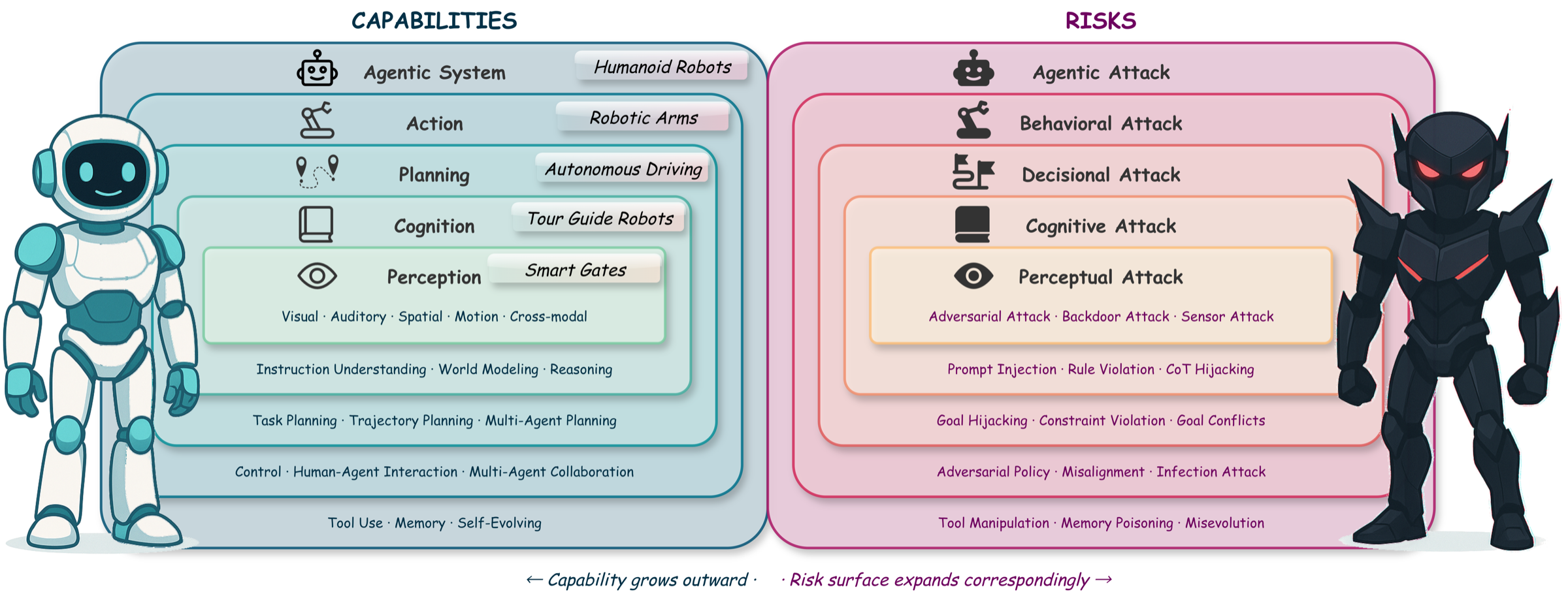
Capability vs. Risk Duality

Figure 1: Capability vs. risk duality in embodied AI systems. As capabilities expand outward from perception to agentic systems, the attack surface grows correspondingly — vulnerabilities at inner layers cascade to outer layers.

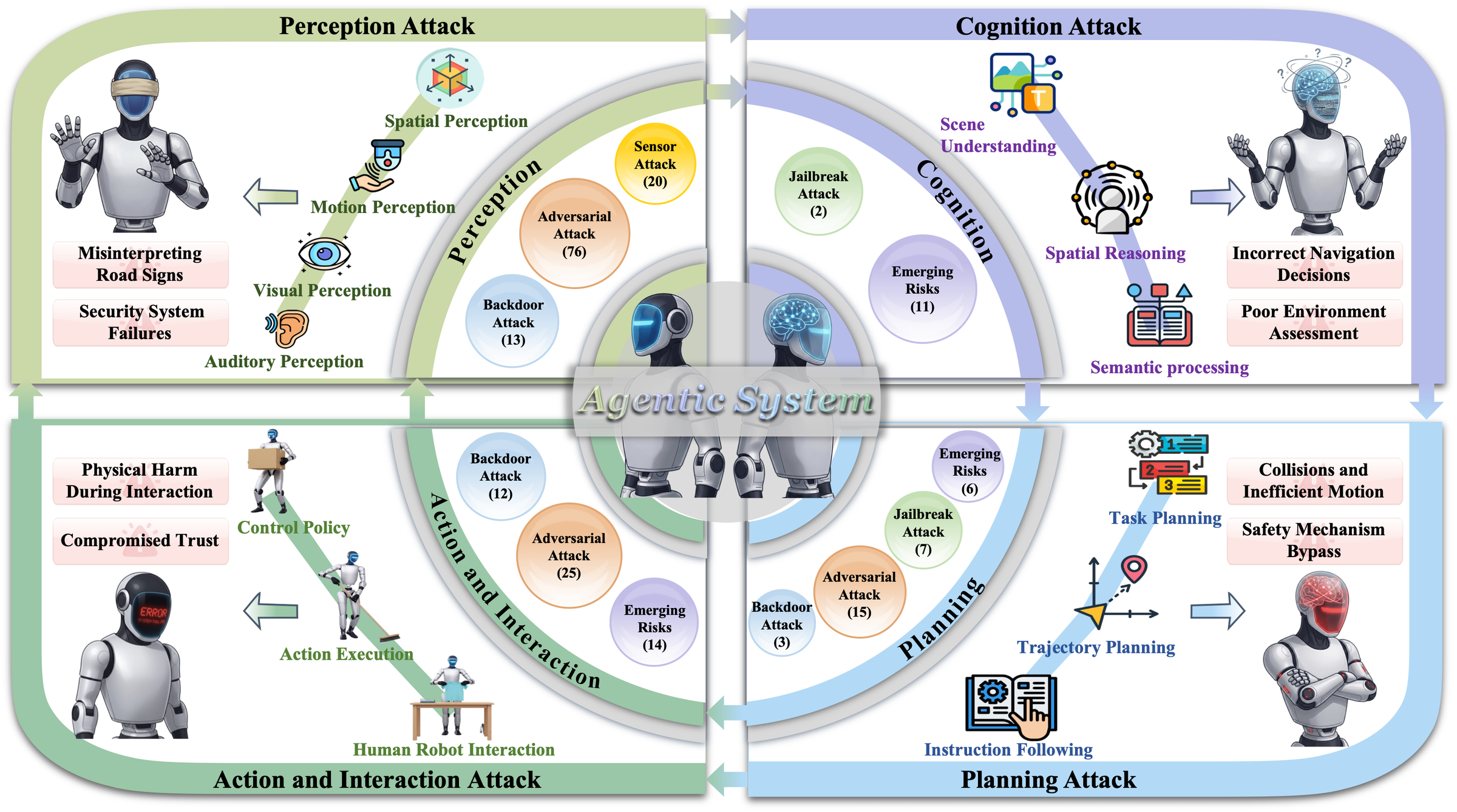
Survey Structure

Figure 2: Illustration of safety threats and attack surfaces across capability layers of embodied AI systems.

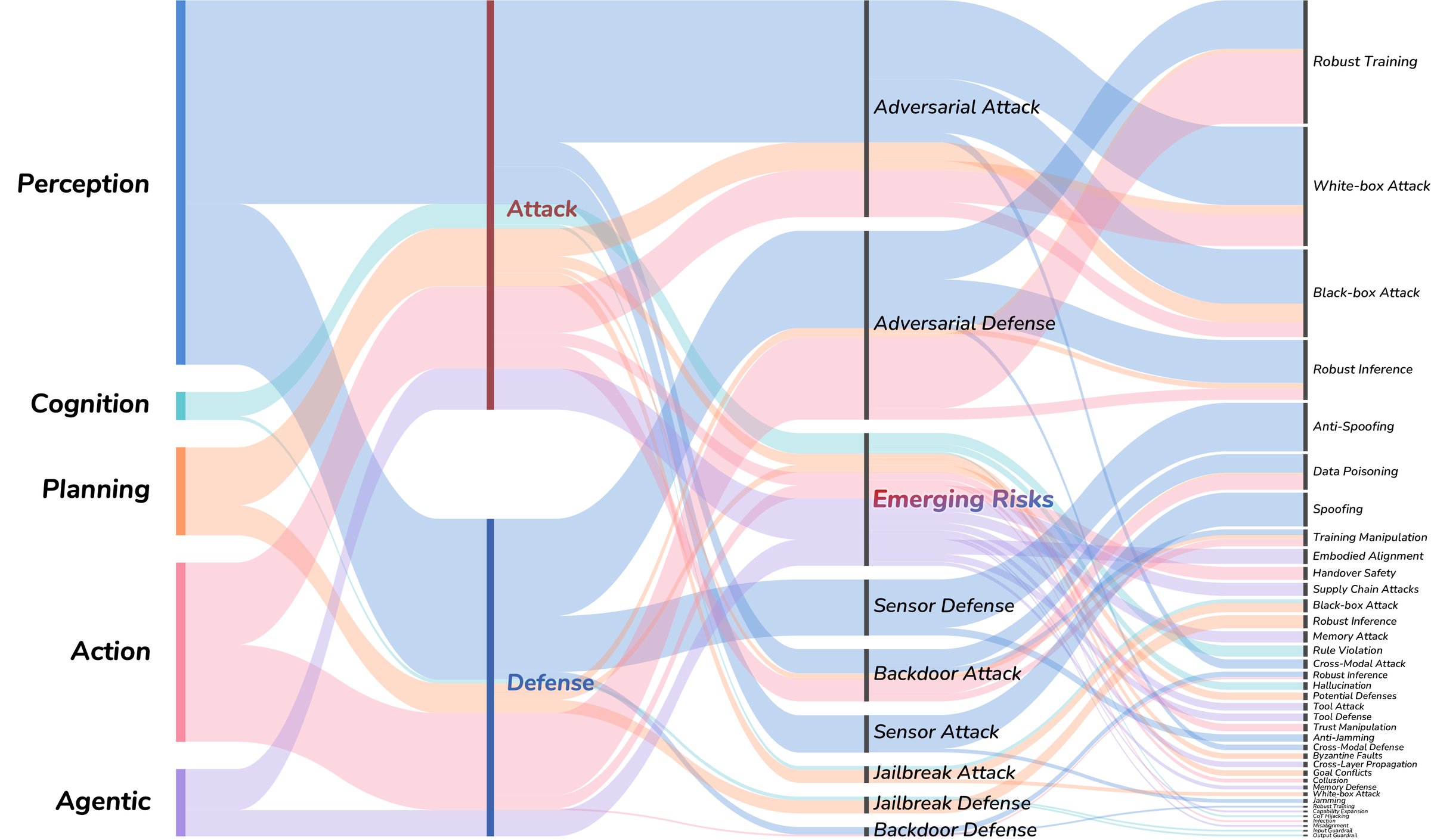
Overview of Attack and Defense Methods

Figure 3: Overview of representative attack and defense methods across perception, cognition, planning, action & interaction, and agentic system layers. The width of the strips is proportional to the number of reviewed works.

Survey Scope

We review 480+ papers across five capability layers of embodied AI, covering adversarial, backdoor, jailbreak, and hardware-level attacks alongside detection, safe training, and risk-aware interaction defenses.

Layer Topics Covered Papers
Perception
Visual · Auditory · Spatial · Motion · Cross-Modal Perception
192
Cognition
Instruction Understanding · World Model · Reasoning
38
Planning
Task Planning · Trajectory Planning · Multi-Agent Planning
59
Action and Interaction
Robot Control · Human-Agent Interaction · Multi-Agent Collaboration
105
Agentic System
Tool Use and Skill · Memory · Self-Evolving · Cascading Risks
87
Total (unique papers in taxonomy) 481

Surveyed Papers

Perception 192 papers
Visual Perception (56)
Auditory Perception (21)
Spatial Perception (59)
Motion Perception (48)
Cross-Modal Perception (8)
Cognition 38 papers
Instruction Understanding (15)
World Model (13)
Reasoning (10)
Planning 59 papers
Task Planning (22)
Trajectory Planning (24)
Multi-Agent Planning (13)
Action and Interaction 105 papers
Robot Control (90)
Human-Agent Interaction (12)
Multi-Agent Collaboration (3)
Agentic 87 papers
Tool Use and Skill (17)
Memory (17)
Self-Evolving (16)
Cascading Risks (37)

Contribute

This survey is a living document. We welcome the community to help keep it current and comprehensive.

📄
Submit a Missing Paper
Found a relevant paper we haven't covered? Submit it with the venue, year, link, and a brief note on which layer it belongs to. We review submissions regularly.
+ Submit Paper
🌐
Suggest a Taxonomy Change
Think a topic is missing from our taxonomy, or a sub-category should be reorganized? Open a discussion — we're actively improving the framework.
Open Discussion
Review process: Submitted papers are reviewed against our inclusion criteria (must involve safety in an embodied pipeline layer) and added in batches. Accepted contributions are credited in the repository.

News

Citation

If you find this survey useful in your research, please cite:

@article{li2026safety,
  title   = {Safety in Embodied AI: A Survey of Risks, Attacks, and Defenses},
  author  = {Li, Xiao and Zheng, Xiang and Gao, Yifeng and Xia, Xinyu and Wang, Yixu and Wang, Xin and Sun, Ye and Zhao, Yunhan and Wen, Ming and Li, Jiayu and Chen, Zixing and Gong, Xun and Liu, Yi and Li, Yige and Wu, Yutao and Wang, Cong and Sun, Jun and Cao, Yixin and Chen, Zhineng and Chen, Jingjing and Gui, Tao and Zhang, Qi and Wu, Zuxuan and Qiu, Xipeng and Huang, Xuanjing and Zhang, Tiehua and Wei, Zhipeng and Wang, Kun and Li, Xinfeng and Huang, Hanxun and Erfani, Sarah and Bailey, James and Wang, Jianping and Xiao, Chaowei and He, Ran and Li, Bo and Ma, Xingjun and Jiang, Yu-Gang},
  journal = {arXiv preprint arXiv:2605.02900},
  year    = {2026},
  url     = {https://arxiv.org/abs/2605.02900}
}